EN Proton – charged up for success
Press-centre / News,
The Progeny section features varieties from EkoNiva’s portfolio. Today, the spotlight falls on the Group's in-house soya bean variety EN Proton, a major breakthrough in the breeding of high-protein crops. Let’s take a look at its genealogy and find out how it was created.
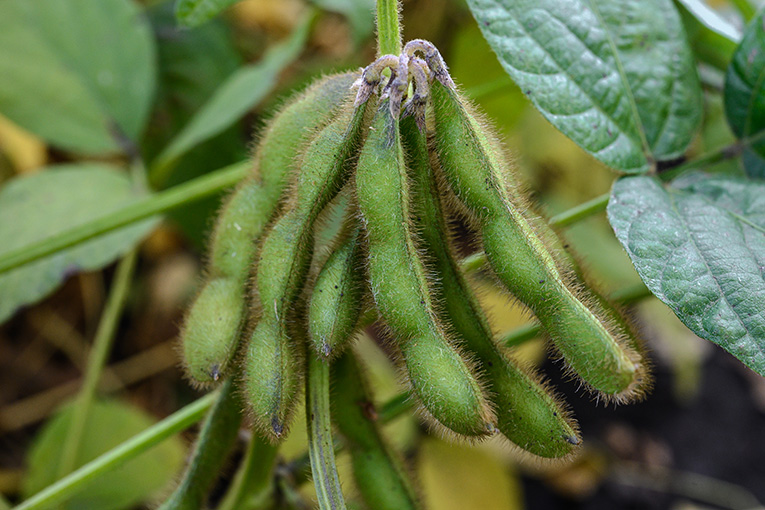
Genetic triumph
The history of EN Proton soya beans began with an ambitious goal – to breed a variety with a high protein content that could successfully ripen in northern latitudes. To do this, the specialists went for a bold experiment, crossing two very dissimilar parents and using the genetic diversity of the material from the bank of the Group’s plant breeding and seed growing subdivision. The key trait to be inherited by the variety was a genetically determined high protein level. However, both parents were significantly more late-maturing – one barely managed to ripen in the Central Black Soil region, while the other failed to do so at all in these conditions.
‘The task seemed next to impossible: how to get the best out of the parents – protein – and at the same time, make the offspring mature much earlier? The clue was found thanks to a meticulous scientific work’, comments Vladislav Rosenzweig, a breeder at EkoNiva Group. ‘We combined genes responsible for a neutral reaction to the day length in the variety – the ones that allow it to adapt to northern latitudes. As a result, what is called a transgression occurred: the offspring surpassed both parents. EN Proton inherited the genes for a consistently high protein from them and managed to ripen a lot earlier. Thus, a new variety appeared, which performs great in Bryansk, Ryazan oblasts and even Altai area and the Far East, while maintaining excellent grain quality.’
Behind the scenes of plant breeding
‘Each variety has its own unique “passport”. Looking at the operating number EN 1432, under which EN Proton passed the state trials, one can discover its history. The first two digits, 14, specify the year of hybridisation – 2014. The rest, 32, stands for the number of the hybrid combination’, continues Vladislav Rosenzweig. ‘Before planning the hybridisation, there was an in-depth study of our genetic collection. With the help of molecular markers and special backgrounds with artificial lighting, we were able to literally look into the DNA of the parent varieties and determine the key genes responsible for early maturity and protein content. This knowledge made for selecting the right parent pair and achieving the desired result.’
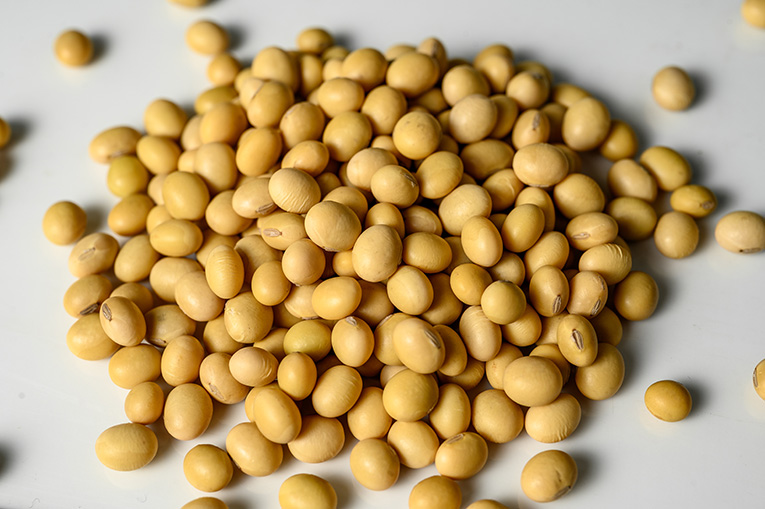
Searching for balance
It is a well-known fact that there is a negative correlation between yielding capacity and protein content. Its synthesis is one of the most energy-consuming processes for plants. On average, a 1% increase in protein content leads to a 2% decrease in output. The task of breeders is to strike the perfect balance, which is the case with EN Proton. It became the first Russian commercial variety with an ultra-high protein content. The figures speak for themselves: 46-47% following the state trials and up to 50% according to the experts of the Group’s plant breeding centre. There are only a few varieties with similar indicators in the State Register. But most importantly, EN Proton delivers just about 0.2 t/ha less yields compared to the most productive varieties, which is an outstanding result for the high-protein segment.
‘The variety has a more consistent protein content than its closest counterparts, whose protein levels may fall to 36% due to drought. Even under unfavourable conditions, this parameter of EN Proton is 3-4% higher than that of the competing varieties’, says Denis Goloyenko, a breeder at EkoNiva Group.
Feeling at home
EN Proton soya bean variety is ready to unlock its potential in various parts of Russia. State tests have confirmed its high adaptability. It is registered for the Central Non-Black Soil region and the Far East. Since the variety belongs to the ultra-early maturity group (000), it requires a relatively small sum of active temperatures – about 2,200 °C.
‘The genetic predisposition to the day length response allows EN Proton to grow comfortably in northern regions, up to the 53rd parallel. A striking example is Amur oblast, where the variety ripened in just 103-104 days last season, showing yields at the level of the local standard (2,6 t/ha) and surpassing it by the protein content – 46-47% (versus 39-40%)’, points out Denis Goloyenko.
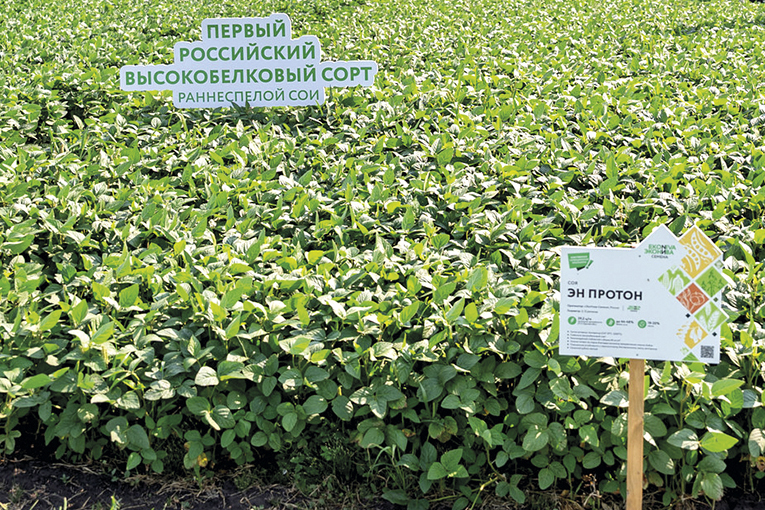
Decided edge
‘Due to its high protein content, EN Proton is ideally suited for preparing top-quality meals, such as white flakes, with the parameter amounting to about 60%’, emphasises Vladislav Rosenzweig. ‘This opens up new opportunities for manufacturers of feed and soya bean processing products. Another area of use is the balancing of grain batches. EN Proton can be blended with less protein-rich batches, thus enhancing the overall quality of the grain mixture and the production efficiency.’