Shaping the future of agriculture with schools
Press-centre / News,
The personnel issue is particularly acute in the Russian farming sector. One of the tools to tackle it is the creation of agritech-classes. In the 2025-2026 academic year, this specialisation was officially included in the curricula of the country’s schools as part of the Technological Support for Food Security national project. EkoNiva Group started carrying out career guidance for pupils more than 10 years ago. With the launch of the initiative by the Ministry of Agriculture of the Russian Federation, the company has become one of the leaders in the systematic development of agritech-classes in Russia.
At the origins
A project set up in Maslyanino district of Novosibirsk oblast became the starting point for advancing the system of specialised classes at EkoNiva. School No. 1 in Maslyanino village was the first one to offer comprehensive agricultural knowledge back in the 2015-2016 academic year. Aleksandra Lyakhova, Highest-Category Methodologist of Agritech-Classes, is one of the founders of the project and its permanent manager:
‘Taking the study of the farming sector to a new level was a joint initiative of the school management and EkoNiva’s Siberian subdivision. At that time, there were no concepts of "agriclass" or "agritech-class". We took the research resources as a basis and enhanced them with a practical component by visiting the holding’s enterprises, solving technological problems during lessons, participating in competitions and Olympiads. Following the first year of work, five of our graduates entered a prestigious agricultural university.’
Aleksandra used her own unique experience as the foundation for the project activities: in grades 10-11, she attended the Junior Agricultural Academy of the Siberian Branch of the Lenin All-Union Academy of Agricultural Sciences. Then, she pursued studies and postgraduate training at Novosibirsk State Agricultural University and completed her doctoral thesis defence and research papers on veterinary medicine.
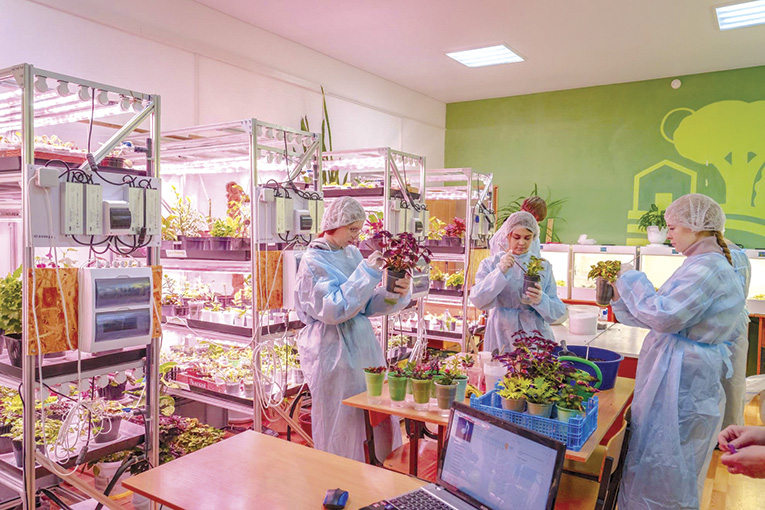
Since 2025, a brand-new educational project has been launched based in the Secondary Comprehensive School named after P. P. Lanovenchik in Maslyanino district, which has become a pilot platform for the HR in Agriculture federal initiative. With the support of the strategic partner EkoNiva, the school implements an innovative seamless learning model, working closely with the region’s leading universities and colleges – the Siberian University of Engineering and Biotechnology, Maslyanino Agricultural College and the Higher School of Economics. Four key Agroquantorium areas are currently available – the pupils can immerse themselves in the world of biotechnologies of food production, efficient livestock farming, agricultural engineering and floriculture.
From theory to practice
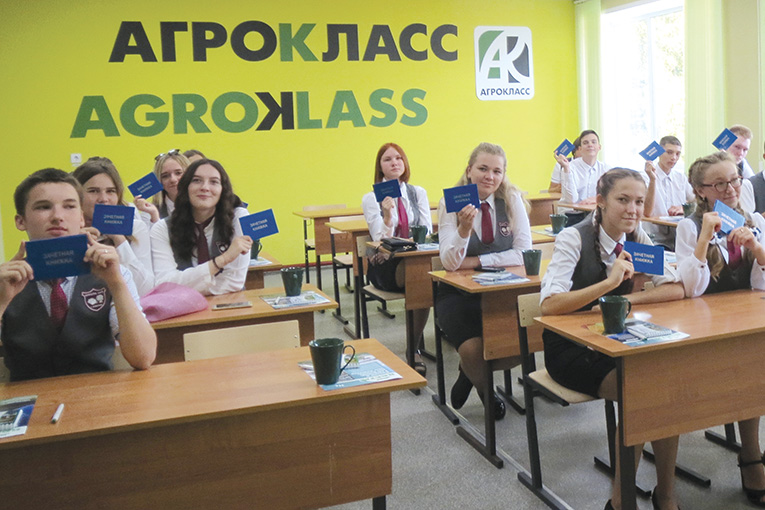
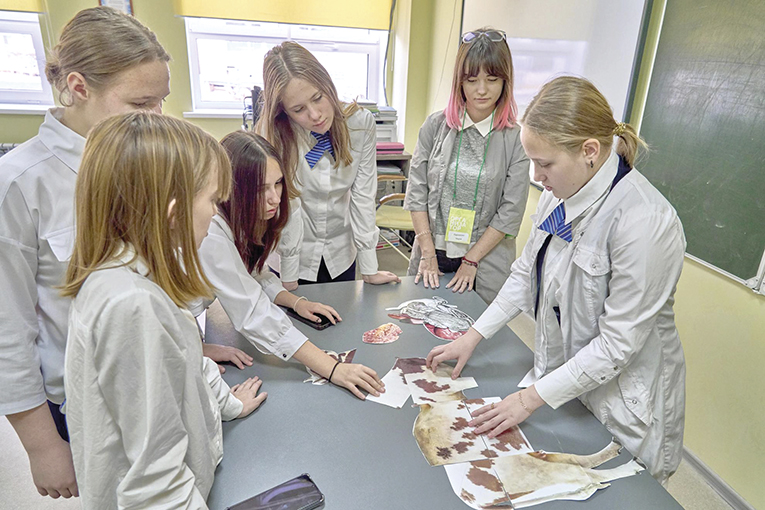
The learning process at the school is both scientific and creative. In the food biotechnology laboratory, the pupils conduct tastings along with mastering the professions of an ice cream technologist and a barista, working with alternative coffee substitutes native to Siberia. Starting from the new academic year, the curriculum will be expanded with courses on baking, cheese making, working with modern simulated agricultural machines and studying the basics of veterinary medicine using training models.
Recognition
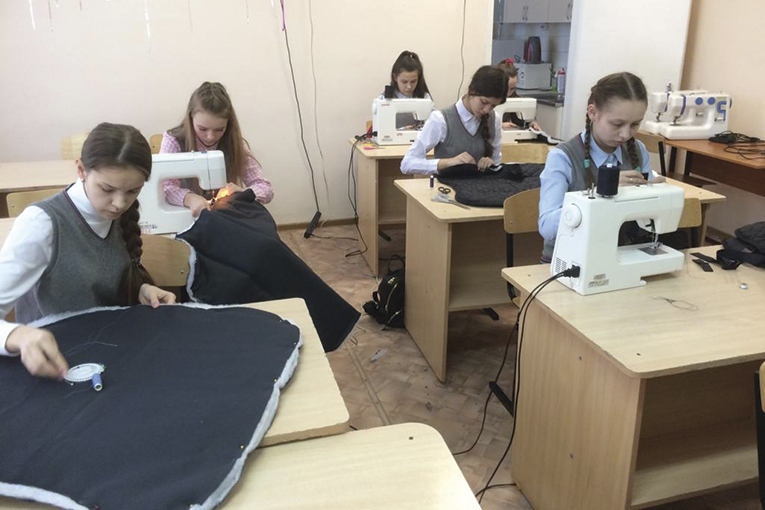
One of the first striking agriclass projects was tailoring winter jackets for calves. The pupils independently developed and sewed the goods, the cost price of which turned out to be several times lower than the market one. Later, the agritech-class trainees mastered 3D printing and launched mass production of orthopedic hoof blocks and safe fistulas for cows. This project sparked serious interest among the experts of the Skolkovo Innovation Centre.
Maslyanino school pays special attention to the training of its agriclass teachers. They do their master’s degrees in the respective fields of specialisation at Novosibirsk State Agricultural University. Aleksandra Lyakhova explains:
‘It is difficult for a traditional educator, even a very good one, to immerse children deeply in the industry. This additional training provides teachers with relevant knowledge and a clear understanding of what they should transfer to pupils and for which purpose.’
The percentage of agriclass graduates enrolled in specialised universities is several times higher than the corresponding figure for regular classes. Overall, EkoNiva’s experience in Maslyanino has become a ready-made model for training HR for agriculture throughout the country.
Project geography
Currently, with the participation of EkoNiva, 45 agritech-classes have been opened in Russia, comprising 906 schoolchildren studying in nine regions: Voronezh, Kaluga, Kursk, Moscow, Ryazan, Leningrad, Novosibirsk oblasts, Altai area and the Republic of Tatarstan. In total, 25 schools are involved in the project, and 8 state universities and 3 colleges have become its partners. Following the 2025-2026 academic year, over 160 ninth-graders and more than 50 eleventh-graders graduated from agritech-classes under the company’s supervision.
In 2026, EkoNiva plans to expand its presence to 34 schools and 86 classes, launching the project in Ryazan oblast in particular: at Aleksandro-Nevskiy District School, Shatsk Boarding School and Chuchkovo Secondary School. Further, in partnership with Moscow Veterinary Academy named after K.I. Skryabin, two classes will be opened in the region: at School No. 8 in Zhukovskiy and School No. 2 in Kolomna. The long-term blueprint is to launch a soil science class at Moscow State University’s gymnasium.
Tangible advantages
The major benefit of agritech-classes is their immediate connection with real-world production. EkoNiva organises trips for the pupils to its farms and plants to give them access to technologies that cannot be demonstrated at school. They learn the ins and outs of professions from within to be able to make a conscious choice of the future career.
Each agritech-class has an overseer from the company coordinating the interaction between the school and production facility and an agricultural mentor who helps the pupils to master the profession in practice. Industry experts are engaged in the lessons as well – they hold consultations and workshops. Besides, a homeroom teacher is in charge of the pupils at school. Such multi-level training makes for maximising knowledge and practical experience.
‘The immersion in the profession begins from the 7th grade: the pupils visit high-tech farms, milk plants and laboratories. For those in grades 8-11, we run several crash courses per year with in-depth practice’, says Alina Ryazantseva, Head of Talent Pool Development Department at EkoNiva Group.
After the 9th grade, the pupils can go to college and transfer to a sponsored-education course during the studies. Along with the academic scholarship, they receive an additional five thousand rubles per month from the company. The second way is to graduate from the 11th grade of school before opting for sponsored university education. In this case, the scholarship is seven thousand rubles.
The project is a good stepping stone to future success both for the pupils and the company. The former are free to choose any university and specialty – EkoNiva cooperates with over fifty institutions across the country within the framework of sponsored training. With agritech-classes, the Group covers its need for qualified employees and strengthens the trust in the company as a reliable partner.